Ager Medicinae
 Tile mosaic commission for Nya Karolinska Sjukhuset / New Karolinska Solna University Hospital
Bricks in the wall

Glass mosaic commission for Segeltorp school, Stockholm
Planned for construction spring 2012.
Kristoffer Zetterstrand: King of Old School
By Mathias Jansson.
From ART21.org . Original Article Here
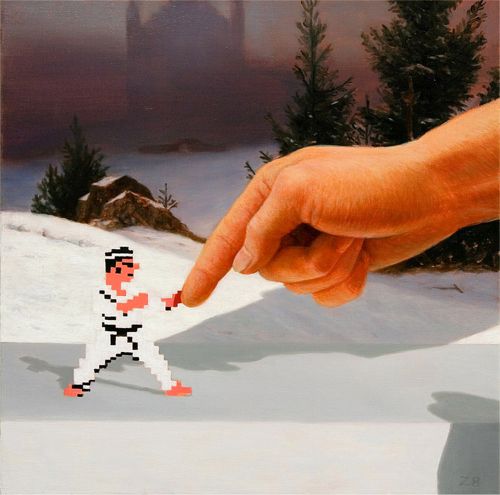
Kristoffer Zetterstrand. “Pointer,” 2008. Oil on canvas. 41 x 41 cm. Courtesy the artist.
Kristoffer Zetterstrand is my favorite game artist, but it would be unfair to label him a game artist. There are very few if any artists that work exclusively with videogames and art. Instead, videogames are one of many tools and sources that artists can use to create their works. Zetterstrand is interesting, because he was trained as a classic painter. He makes large oil canvases, but he starts by creating a 3D-model with help of software tools such as Maya. In the computer, he can mix and arrange the objects and experiment with different angels and lightning before he starts to paint on the canvas.
It all started in 2002, with the game Counter-Strike and a killing. During a play session, Zetterstrand was killed and found that he was floating outside the graphic in a virtual near-death experience. The effect fascinated him, and he started to paint the landscape in the game where the graphic ended in nothingness. He named this series of paintings Free-look Mode, which is a term used in 3D games to describe the choice of the player to move or fly in any direction in the game.

Kristoffer Zetterstrand. Painting from the series “Free Look Mode,” 2002. Oil on MDF. 41×49 cm. Courtesy the artist and Galleri Peter Bergman, Sweden.
After the Free-Look Mode series, Zetterstrand continued to explore the world of videogames, and started to include elements from art history mixed with early computer graphics. For example, in the painting Pointer (pictured above), we see a character who could been taken from a Kung Fu game from the eighties and a landscape that bears similarities to those of romantic painters such as Casper David Friedrich. When I first saw Zetterstrand’s painting I thought it looked like a paraphrase of Michelangelo’s The Creation of Adam on the Sistine Chapel ceiling. Zetterstrand says that he wasn’t aware of that resemblance until people mentioned it to him afterwards. Pointer could also be the hand we see on the screen when we click on an Internet link or are moving an object in a drawing program. The human hand in the painting could also symbolize the creation of virtual life. God created Adam and humankind, and they in turn created virtual characters in online worlds and videogames.

Kristoffer Zetterstrand. “Old school” shown at Bromma gymnasium, Stockholm. Glass mosaics. Commissioned by Stockholms konstråd / Stockholm Art Council 2007. Completed Spring 2008.
In the painting Pointer, you can see traces of pixel art, as is the case in many other of Zetterstrand’s works. The pixel is an essential part of the early computer graphic aesthetics, which was created with small squares in different colours. In game art you can find many artists working with pixel aesthetics from era of early computer graphics. It’s both a nostalgic approach and a reminiscence of 8-bit videogames played in childhood, like Super Mario, Space Invaders, and Donkey Kong. But it’s also a reaction against today’s hyper-realistic videogame graphics. When you create pixel art on a computer, it is not unlike how you create a mosaic. You use small pieces with different colors put together to create a pattern. In game art, artists often use the technique of creating mosaics that is at least 5000 years old. One well-known artist in the field goes by the name Space Invader, an alias for a French street artist that travels around the world putting up small mosaics on walls with characters from famous videogames like Space Invaders and Super Mario. Zetterstrand has also created mosaic works for different public locations. For instance, he was commissioned in 2008 to create Old School, a work consisting of seven large glass mosaics for Bromma High School in Sweden. In these mosaics were depictions of objects collected from old-school videogames.
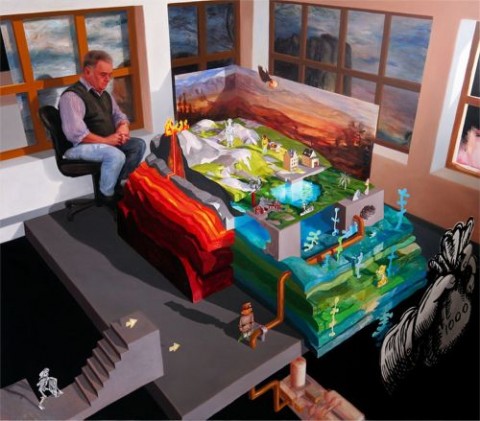
Kristoffer Zetterstrand. “The game,” 2009. 228 x 200cm. Oil on canvas. Courtesy the artist.
In his latest work, Zetterstrand has launched into meta-art. In his paintings he includes traces of the process of painting and sometimes, of the painter himself. Zetterstrand’s The game, 2009, depicts an intersection of a landscape with different layers. It could be interpreted as an intersection of a model of a landscape, and also of an image of the process of creating a digital landscape, when designers are working with different layers as in Photoshop or 3D-programs. The landscape in the painting is also a mixture of 3D and 2D objects with more realistically-painted and pixeleted objects. The painting has many layers: it shows a model placed in a studio, but the windows in the background is not real, the view outside is made of paintings, and so on.
Zetterstrand’s interest in virtual landscape and videogames has also led to a collaboration with the Swedish indie game company that created Minecraft, a game designed by Markus Persson in which you build everything with help of different-colored blocks. Nineteen of Zetterstrand’s works were re-crafted and included in Minecraft’s latest gamepack. Virtual worlds and videogames have over the past few years proved to be a new and important art scene for artists. In Second Life, for example, artists have created art and exhibitions and artists as Joseph Delappe has used online games such as America’s Army and Medal of Honor to make performances and reach new audiences. Zetterstrand describes the result of his collaborations on Minecraft as the “The Notch Effect.” After the release of the new gamepack that included his art, visits to his website increased from 400 per day to 13,500. So videogames can not only be used to create art, they can also be an important way to exhibit art and to reach new audiences.
So why is Kristeroffer Zetterstrand my favorite game artist? As I wrote in my first post, game art fascinates me because of its juxtaposition of high and low culture. Zetterstrand is classic painter, but he uses new techniques like 3D software programs to sculpt his work before he starts to paint, in this way mixing elements from art and videogame history in the same picture. There is also a blend of 2D and 3D objects, and of realistic painting with objects with visible pixels. He brings the best of two worlds–art and videogames–together, and he does so in new and exiting ways. And of course, he’s a really good painter, too.

In the Land of Double Letters
Roslyn Bernstein: In the Land of Double Letters: Artists’ Housing and Studios in Scandinavia
Whatever their living and studio situation, the goal of most artists is to have their work shown.
By Roslyn Bernstein
http://www.arterritory.com/en/blogs_video/blogs/688-in_the_land_of_double_letters/
http://www.guernicamag.com/blog/3438/roslyn_bernstein_in_the_land_o/
MineCon, Las Vegas

Attending MineCon for the release of Minecraft
Mandalay Bay, Las Vegas – 18-19 November
Art Copenhagen 2011

Participating at Art Copenhagen – The nordic art fair
16 – 18 September 2011
Stand 44, Peter Bergman Gallery
The world’s most exposed artist
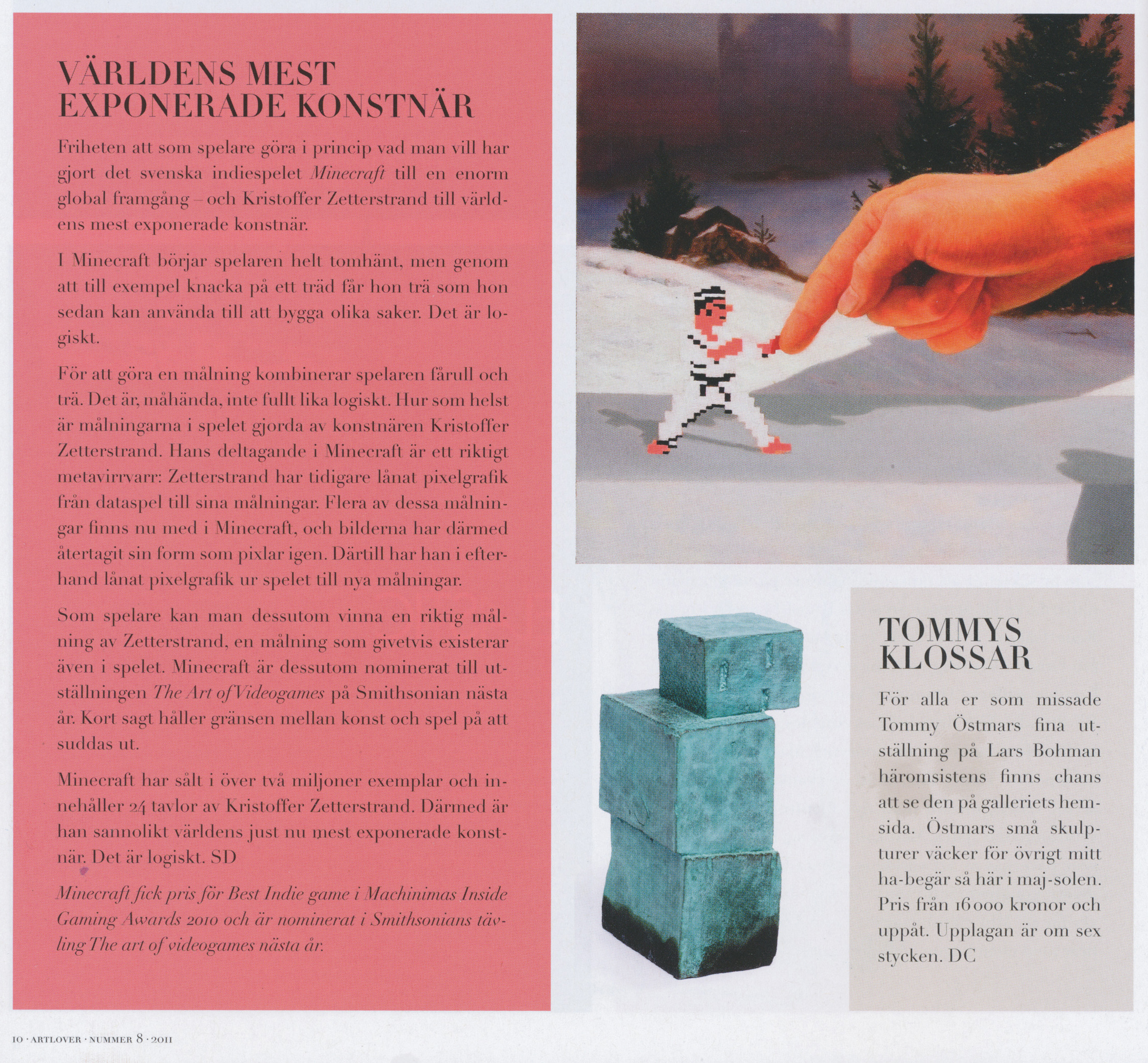
The freedom of the player to do almost anything you want has made the Swedish indie game Minecraft an enormous global success – and Kristoffer Zetterstrand the world’s most exposed artist.
In Minecraft, the player starts out completely empty handed, but by for example knocking on a tree she gets wood that then can be used to build different things. That’s logical.
To make a painting, the player combines sheep’s wool and wood. That is, perhaps, not quite as logical. However, the paintings in the game are made by the artist Kristoffer Zetterstrand.
His participation in Minecraft is a veritable meta-clutter. Earlier, Zetterstrand has borrowed pixel-graphics from computer games for his paintings. Several of these has been put in Minecraft, and the pictures have therefore reclaimed their form as pixels again. Also, he has borrowed pixel graphics from Minecraft to make new paintings.
As a player, you can also win a real painting by Zetterstrand -a painting that of course is present in the game too. Furthermore, Minecraft is nominated to the exhibition “The art of Videogames” at the Smithsonian next year. To put it briefly, the border between art and games are fading.
Minecraft has sold over two million copies and includes 24 paintings by Kristoffer Zetterstrand. That means he is probably the world’s most exposed artist right now. That’s logical.
SD
Minecraft was awarded the price for best indie game at Machinima’s Inside Gaming Awards 2010 and is nominated for Smithsonian’s “The art of videogames” next year.
———————————
Världens mest exponerade konstnär
I Minecraft börjar spelaren helt tomhänt, men genom att till exempel knacka på ett träd får hon trä som hon sedan kan använda till att bygga olika saker. Det är logiskt.
För att göra en månling kombinerar spelaren fårull och trä. Det är, måhända, inte fullt lika logiskt. Hur som helst är målningarna i spelet gjorda av konstnären Kristoffer Zetterstrand. Hans deltagande i Minecraft är ett riktigt metavirrvarr. Zetterstrand har tidigare lånat pixelgrafik från dataspel till sina målningar. Flera av dessa målningar finns nu med i Minecraft, och bilderna har därmed återtagit sin form som pixlar igen. Därtill har han i efterhand lånat pixelgrafik från spelet till nya målningar.
Som spelare kan man dessutom vinna en riktig målning av Zetterstrand, en målning som givetvis existerar även i spelet. Minecraft är dessutom nominerat till utställningen The Art Of Videogames på Smithsonian nästa år. Kort sagt håller gränsen mellan konst och spel på att suddas ut.
Minecraft har sålt i över två miljoner exemplar och innehåller 24 tavlor av Kristoffer Zetterstrand. Därmed är han sannolikt världens just nu mest exponerade konstnär. Det är logiskt. SD
Minecraft fick pris för Best Indie game i Machinimas Inside Gaming Awards 2010 och är nominerat i Smithsonians tävling The art of videogames nästa år.
An artist you should know
http://dimensionnumerofive.blogspot.com/2011/06/artist-you-should-know-kristoffer.html
 If you’ve played the immensely popular sandbox-style game Minecraft, you might be familiar with Swedish painter Kristoffer Zetterstrand’s artwork without even realizing it. Zetterstrand has long been interested in the way traditional art like painting intersects with the 3-D landscapes generated by computers in games… [Read more]
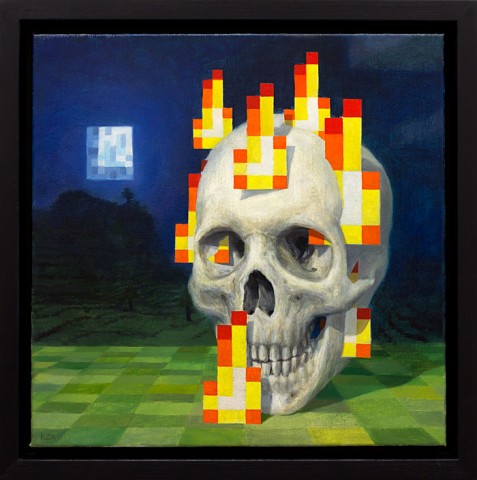
If you’ve played the immensely popular sandbox-style game Minecraft, you might be familiar with Swedish painter Kristoffer Zetterstrand’s artwork without even realizing it. Zetterstrand has long been interested in the way traditional art like painting intersects with the 3-D landscapes generated by computers in games; he once did a series of lansdcapes based on the views in Counter-Strike–but only the views the player could see when “dead” and lying on their back. In Minecraft, players can create paintings to hang on the walls of their houses. The randomly-selected images include the work of Zetterstrand, includingSkull on Fire and Pointer. (The selection also includes Caspar David Friedrich’s Wanderer above the Sea of Fog).

His oil-on-canvas paintings incorporate traditional oil painting techniques, resulting in realism, with flat, cartoonish images, and solid blocks of color that evoke the pixelated images of computer games. His work also speaks to the creation and generation of landscapes as understood and designed by the human mind, and imagines things like game worlds outside of the confines of a computer screen, as three-dimensional lands. The Gameillustrates this idea quite well, with the human figure considering the miniature landscape sprawling over his desk. This idea of creation and design inevitably recalls philosophical and religious debates, as is explored in Intelligent Design, which also showcases some of Zetterstrand’s black and white work. In both of these paintings, a human is considering an abstract idea by laying out his thoughts in front of himself, it seems, in the form of a series of images for him to consider. (I don’t know if this was what Zetterstrand was going for, but I know that’s how I think, and so that is the conclusion I naturally draw.) The human figures are separate from the images before them, but simultaneously linked to them on a deep level.
His work is meticulously detailed and he pays special attention to his use of color and style, often juxtaposing two seemingly opposite styles to achieve a startling effect. You can check out more of his work and information about his inspirations and work on his website.
The Girl With The Dragon Tattoo
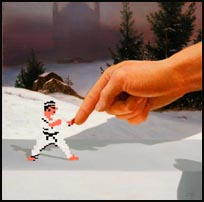
The company producing the Hollywood adaptation of “The Girl with the Dragon Tattoo” purchased the rights to use the painting “Pointer” in the movie. Let’s see if it makes it to the final cut….