La caccia al tesoro artistico…
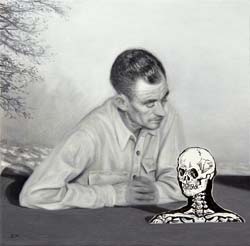
Frutto della fantasia esplosiva del game designer svedese Markus “Notch” Persson, Minecraft è un videogame di costruzioni per adulti, un Lego procedurale che miscela pixel art e retrofuturismo. Introdotto in versione “alpha” nella primavera del 2009, Minecraft si è sviluppato rapidamente, grazie al supporto e all’entusiasmo di oltre due milioni di utenti. Con gli introiti ottenuti dalle vendite della versione in progress (!), Persson ha potuto fondare un studio, Mojang Specifications e ottimizzare codice e funzioni di un progetto nato come passatempo. Tra i suoi collaboratori spicca l’artista svedese Kristoffer Zetterstrand. Per chi non lo sapesse, Zeta ha debuttato nel 2002 con una serie di dipinti ispirati a Counter-Strike per poi sviluppare una peculiare Game Art a 8-bit. Nel 2010, il trentottenne artista ha avviato un’interessante collaborazione con Persson. Diciannove dei suoi splendidi dipinti videoludici sono stati digitalizzati e disseminati nel mondo di Minecraft. Zetterstrand ha inoltre offerto un quadro ad hoc (di cui potete vedere un’immagine), al vincitore di una competizione lanciata qualche mese fa. L’autore della migliore texture per Minecraft si portera’ a casa l’opera di Zeta. Un’iniziativa ricorsiva, auto-riflessiva e meta-referenziale, in cui il confine tra l”‘opera che ispira” e l'”opera ispirata” finiscono per confondersi, creando interessanti corto circuiti epistemologici.

Artist works comparison

Kristoffer Zetterstrand’s Art Treasure Hunt…
Whole article here : http://www.gamescenes.org/

If fine art was a busted video game
Article at Kotaku.com
Kristoffer Zetterstrand’s works take traditional painting and smash it head-first into things that aren’t traditional painting. Often, that means video games.
You can see some of his work in the gallery to your left, with classics like Way of the Exploding Fist and King’s Quest tossed into the same piece as fake dioramas of a golden age of painting.
Indeed, games form a big part of his art. Zetterstrand says that his juxtaposition of different art styles — when he says “the illusion is shattered and the underlying construction emerges” — is “like when there is a bug in a computer game”.
Minecraft fans may recognise some of his work; he’s the man behind the paintings available in the indie game.
Kristoffer Zetterstrand
Geek art loves Kristoffer Zetterstrand
Post at geek-art.net
I love you too, Geek-art

Minecraft painting, Webhallen
Painting announced as 1st price in Minecraft Texture Pack Grand Prix competition
Endless Boogie, Berlin
ENDLESS BOOGIE
FORGOTTEN BAR, GALERIE IM REGIERUNGSVIERTEL, – BOPPSTRASSE 5 10967 BERLIN
November 5th
With: Trasi Henen, Kristoffer Zetterstrand, Susann Brännström, Ulrika Segerberg, Roland Persson, Jonte Nynäs, Jan Peter Hammer, Katja Aglert, Veronica Brovall, Donya Saed, Pia Mauno, Lasse Mauno, Emil Holmer, Tim Lehmacher, Sonja Gerdes, Daniel Leander-Kannenberg, Madeleine Boschan, Anneke Eussen, Stephan Balleux, Christian Schwarzwald, Klara Lidén, Oskar Aglert, Joep van Liefland, Daniel Segerberg, Johannes Weiss, Sophie Arfwidson, Munan Ovrelid, Randi Nygård, Anders Kjellesvik, Ninia Sverdrup
Back to the square
Article here : http://www.digicult.it/digimag/article.asp?id=1905
 Other examples are the Swedish artist Kristoffer Zetterstrand who is trained as a traditional painter and creates paintings with a mash up of reference to art history and classic arcade games and in the process he tries to emulate the typical 8-bit feel in his paintings. Zetterstrand has also made several public mosaics where he makes pictures inspired by arcade games.