Kristoffer Zetterstrand
At the heart of care
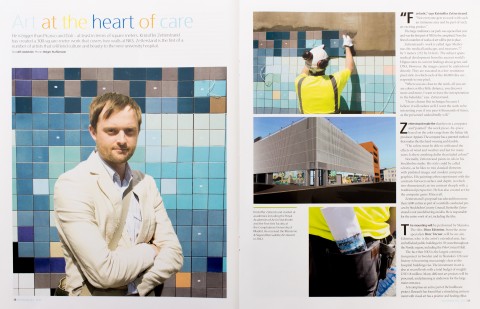
He is bigger than Picasso and Dali – at least in terms of square meters. Kristoffer Zetterstrand has created a 300-square-meter work that covers two walls at NKS. Zetterstand is the first of a number of artists that will lend culture and beauty to the new university hospital.
Skanska Worldwide PDF
“Fantastic,” says Kristoffer Zetterstrand. “Not everyone gets to work with such an immense area and be part of such an exciting project.”
The large multistory car park was opened last year and was the first part of NKS to be completed. Now, the first of a number of works of art will be put in place. Zetterstrand’s work is called Ager Medicinae, the medical landscape, and measures 77 by 5 meters (252 by 16 feet). The subject spans medical development from the ancient world’s Hippocrates to current findings about genes and DNA. However, the images cannot be understood
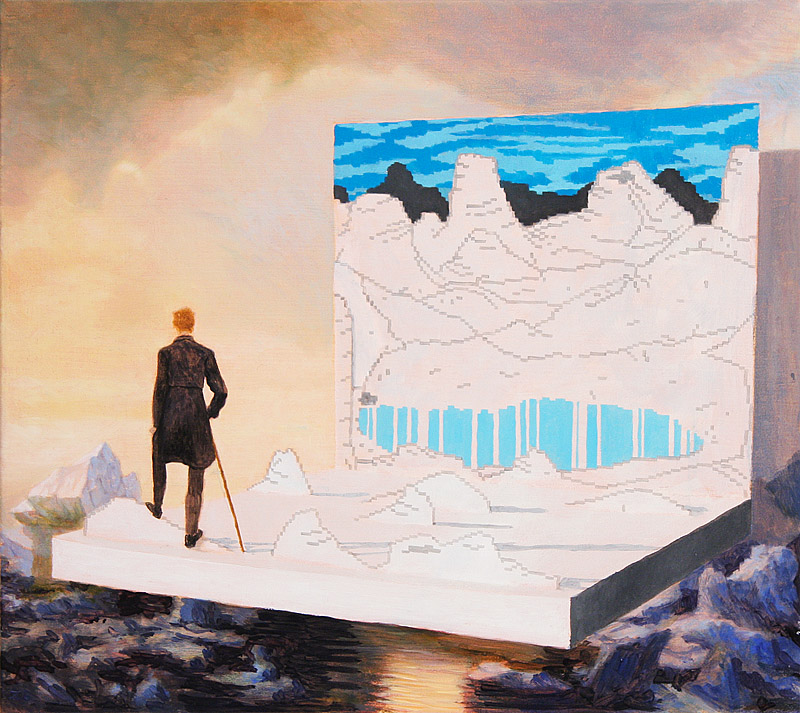
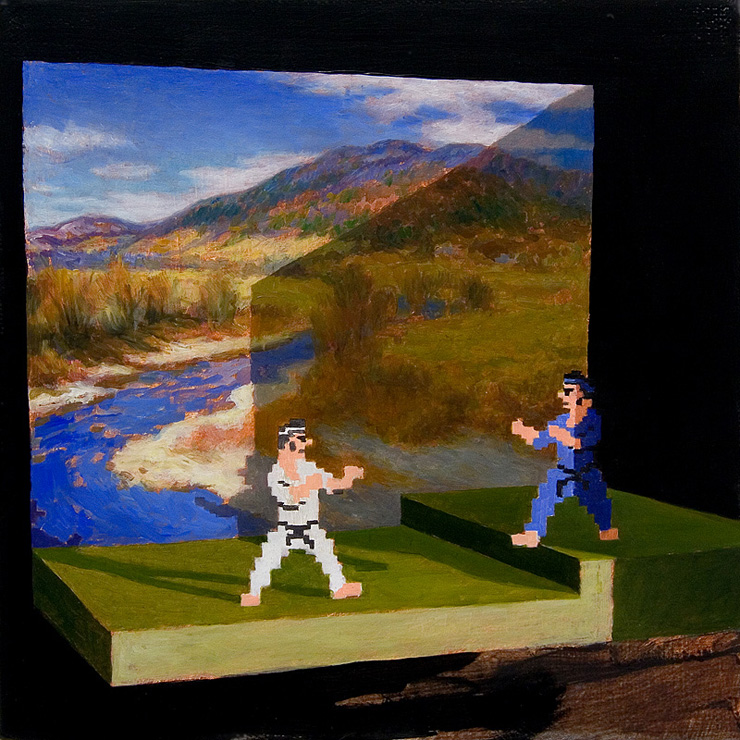
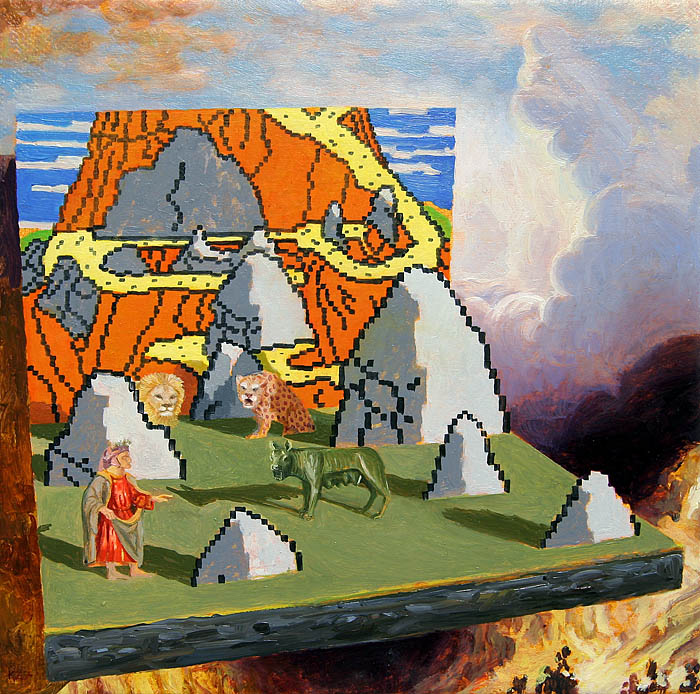
directly. They are executed in a low-resolution pixel style in which each of the 40,000 tiles corresponds to one pixel. “When you are close to the work, all you see are colors; with a little distance, you discover more and more. I want to leave the interpretation to the beholder,” says Zetterstrand.
“I have chosen this technique because I believe it will endure well. I want the work to be interesting even if you pass it thousands of times, as the personnel undoubtedly will.”
Zetterstrand made the sketches on a computer and “painted” the work piece–by–piece based on the color range from the Italian tile producer Appiani. The company has a patented method that makes the tiles hard-wearing and durable. “The colors must be able to withstand the effects of wind and weather and last for many years. Is there anything duller than faded colors?” Normally, Zetterstrand paints in oils in his Stockholm studio. His style could be called eclectic, as he likes to mix classical elements with pixilated images and modern computer graphics. His paintings often experiment with the contrasts between surface and depth, in which two-dimensional cut-ins contrast sharply with a traditional perspective. He has also created art for the computer game Minecraft.
Zetterstrand’s proposal was selected from more than 1,000 entries as part of a carefully conducted process by Stockholm County Council. Kristoffer Zetterstrand is not just delivering an idea. He is responsible for the entire work of art, including the tiles. The mounting will be performed by Skanska. The tiler, Dino Edström, from the stone specialists Bror Törner, will be on-site. Edström, who is the artist’s extended arm, has embellished public buildings or 38 years throughout the Nordic region, including the Oslo Concert Hall. The fact that NKS is the largest construction project in Sweden and in Skanska’s 126 year history is becoming increasingly clear as the hospital buildings rise. The investment in art is also at record levels with a total budget of roughly USD 18 million. Many different art projects will be procured, and planning is underway for the large main entrance. Art comprises an active part of the healthcare project. Research has found that a stimulating environment with visual art has a positive and healing effect.