Art Copenhagen 2011

Participating at Art Copenhagen – The nordic art fair
16 – 18 September 2011
Stand 44, Peter Bergman Gallery
Participating at Art Copenhagen – The nordic art fair
16 – 18 September 2011
Stand 44, Peter Bergman Gallery
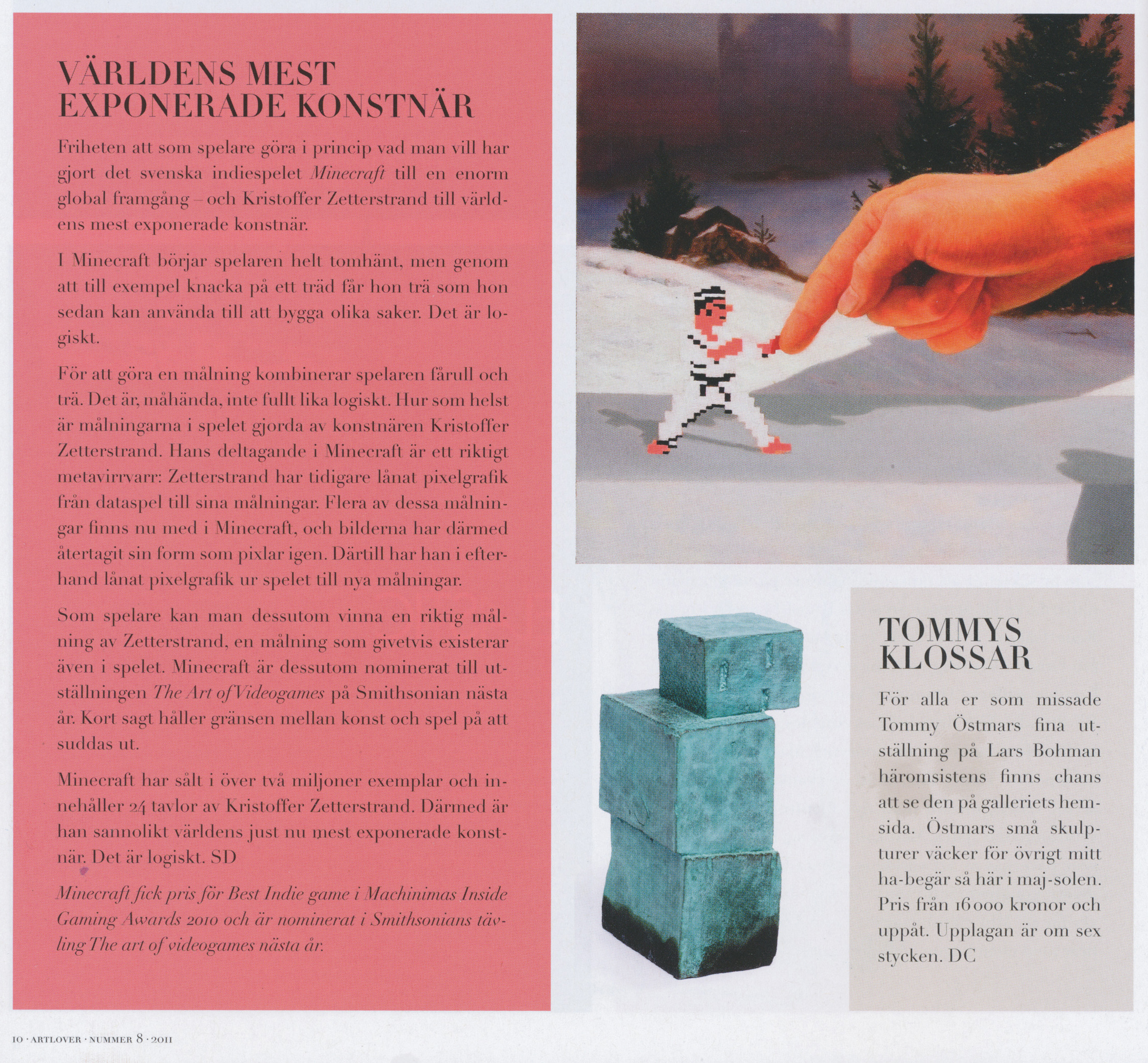
In Minecraft, the player starts out completely empty handed, but by for example knocking on a tree she gets wood that then can be used to build different things. That’s logical.
To make a painting, the player combines sheep’s wool and wood. That is, perhaps, not quite as logical. However, the paintings in the game are made by the artist Kristoffer Zetterstrand.
His participation in Minecraft is a veritable meta-clutter. Earlier, Zetterstrand has borrowed pixel-graphics from computer games for his paintings. Several of these has been put in Minecraft, and the pictures have therefore reclaimed their form as pixels again. Also, he has borrowed pixel graphics from Minecraft to make new paintings.
As a player, you can also win a real painting by Zetterstrand -a painting that of course is present in the game too. Furthermore, Minecraft is nominated to the exhibition “The art of Videogames” at the Smithsonian next year. To put it briefly, the border between art and games are fading.
Minecraft has sold over two million copies and includes 24 paintings by Kristoffer Zetterstrand. That means he is probably the world’s most exposed artist right now. That’s logical.
SD
Minecraft was awarded the price for best indie game at Machinima’s Inside Gaming Awards 2010 and is nominated for Smithsonian’s “The art of videogames” next year.
———————————
I Minecraft börjar spelaren helt tomhänt, men genom att till exempel knacka på ett träd får hon trä som hon sedan kan använda till att bygga olika saker. Det är logiskt.
För att göra en månling kombinerar spelaren fårull och trä. Det är, måhända, inte fullt lika logiskt. Hur som helst är målningarna i spelet gjorda av konstnären Kristoffer Zetterstrand. Hans deltagande i Minecraft är ett riktigt metavirrvarr. Zetterstrand har tidigare lånat pixelgrafik från dataspel till sina målningar. Flera av dessa målningar finns nu med i Minecraft, och bilderna har därmed återtagit sin form som pixlar igen. Därtill har han i efterhand lånat pixelgrafik från spelet till nya målningar.
Som spelare kan man dessutom vinna en riktig målning av Zetterstrand, en målning som givetvis existerar även i spelet. Minecraft är dessutom nominerat till utställningen The Art Of Videogames på Smithsonian nästa år. Kort sagt håller gränsen mellan konst och spel på att suddas ut.
Minecraft har sålt i över två miljoner exemplar och innehåller 24 tavlor av Kristoffer Zetterstrand. Därmed är han sannolikt världens just nu mest exponerade konstnär. Det är logiskt. SD
Minecraft fick pris för Best Indie game i Machinimas Inside Gaming Awards 2010 och är nominerat i Smithsonians tävling The art of videogames nästa år.
http://dimensionnumerofive.blogspot.com/2011/06/artist-you-should-know-kristoffer.html
 If you’ve played the immensely popular sandbox-style game Minecraft, you might be familiar with Swedish painter Kristoffer Zetterstrand’s artwork without even realizing it. Zetterstrand has long been interested in the way traditional art like painting intersects with the 3-D landscapes generated by computers in games… [Read more]
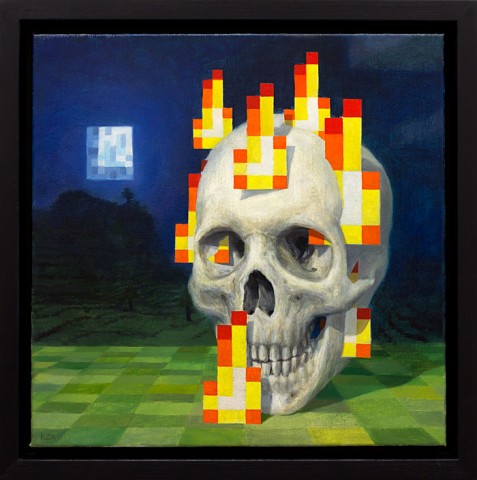
If you’ve played the immensely popular sandbox-style game Minecraft, you might be familiar with Swedish painter Kristoffer Zetterstrand’s artwork without even realizing it. Zetterstrand has long been interested in the way traditional art like painting intersects with the 3-D landscapes generated by computers in games; he once did a series of lansdcapes based on the views in Counter-Strike–but only the views the player could see when “dead” and lying on their back. In Minecraft, players can create paintings to hang on the walls of their houses. The randomly-selected images include the work of Zetterstrand, includingSkull on Fire and Pointer. (The selection also includes Caspar David Friedrich’s Wanderer above the Sea of Fog).
His oil-on-canvas paintings incorporate traditional oil painting techniques, resulting in realism, with flat, cartoonish images, and solid blocks of color that evoke the pixelated images of computer games. His work also speaks to the creation and generation of landscapes as understood and designed by the human mind, and imagines things like game worlds outside of the confines of a computer screen, as three-dimensional lands. The Gameillustrates this idea quite well, with the human figure considering the miniature landscape sprawling over his desk. This idea of creation and design inevitably recalls philosophical and religious debates, as is explored in Intelligent Design, which also showcases some of Zetterstrand’s black and white work. In both of these paintings, a human is considering an abstract idea by laying out his thoughts in front of himself, it seems, in the form of a series of images for him to consider. (I don’t know if this was what Zetterstrand was going for, but I know that’s how I think, and so that is the conclusion I naturally draw.) The human figures are separate from the images before them, but simultaneously linked to them on a deep level.
His work is meticulously detailed and he pays special attention to his use of color and style, often juxtaposing two seemingly opposite styles to achieve a startling effect. You can check out more of his work and information about his inspirations and work on his website.
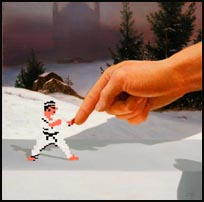
The company producing the Hollywood adaptation of “The Girl with the Dragon Tattoo” purchased the rights to use the painting “Pointer” in the movie. Let’s see if it makes it to the final cut….
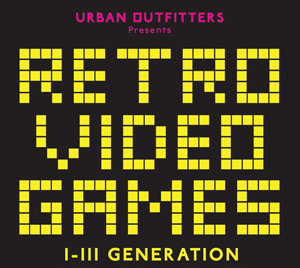
Opening 14th April, 19.30 – 21.30
Lilla galleriet, Urban outfitters. Biblioteksgatan 4
Johan Thurfjell, Cory Archangel, Andreas Ribbung, Arne Kjell Vikhagen, Kristoffer Zetterstrand
