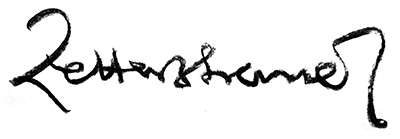
Fönster till nya biblioteket
Från Vallentunasteget, 100330
Interview @ Gamescenes.org
Interview: From traditional painting to Game Art
03/24/2010
This conversation with Swedish artist Kristoffer Zetterstrand, a classicaly trained painter, mixing art history with elements and techniques from videogames, took place via email in November 2009.
GameScenes: In 2002, Swedish gallery ALP/Peter Bergman presented “Free-look Mode”, a series of paintings inspired by Counter-Strike. Was this the first time you used computer games in your works?
Kristoffer Zetterstrand: Yes, It was the first time I made paintings using computer games as an inspiration. I had been influenced earlier on by their aesthetics and design, but never used them in such explicit way. The moment I realized I had to paint scenes based on Counter-Strike was when once I got killed in the game, and suddenly found myself partly outside the graphics, being able to see both the realistic 3D world I was bound to a second ago, as well as the black void outside the game, the graphic card’s rendering of nothingness. I had some sort of an epiphany… It was very beautiful, and I felt the urge to paint it.
GameScenes: What is the rationale behind “Free-look mode”?
Kristoffer Zetterstrand: Counter-Strike is a online team-based game, you have to wait until either team wins and the round restarts if you get killed in the game, and “Free-look Mode” in the game was simply an option to allow the users to keep following the ongoing action (although you were basically dead) by flying freely through the game map, unhindered by whether there were created graphics there or not. Flying through these environments of part realistic landscapes, part abstract void, I found that this was a very interesting re-interpretation of he classical notion of the spirit world; the dead being able to see the still living, but unable to communicate with them, and at the same time seeing through the logical construction of the world… You were also able to chat with the other dead players, and comment on the progress of the game. The images created by the game were also interesting in their unintended abstract qualities, by their mix between convincing realism and ultimate flatness, and I spent a long time trying to get the perfect screenshots. This sometimes meant I tried to get killed as quickly as possible so I could have time to get good shots. I remember getting kicked out of a few servers, because the other players thought I was weird.
GameScenes: In your paintings you often mix references from art history and videogames from the 1980s. What is you relationship to pixel art, and pixels, in general?
Kristoffer Zetterstrand: I find that in early computer graphics, where the creators only had a few colours and a limited resolution to work with, they had to be very creative, using colour and form in innovative ways – and they often produced stunning results. I also like the very idea of the pixel, presented in a sense as the smallest “image part” but still being visibly an object, a rectangle. In my images I like to enlarge these pixels, and to give them a part to play in another context. For example to move them from 2D to 3D, and exaggerate their flatness by having them cast shadows. I also like to experiment with different types of realism and painting styles in my work, treating the different image elements like actors on a stage, each with their own personality.
GameScenes: Is there any resemblance between videogames and art history?
Kristoffer Zetterstrand: Yes, of course. The game designers are not starting from a blank slate. They are just like any artist, consciously or not affected by the inherited imagery and conventions from art history, be it via advertising, movies or whatever. They are also by necessity using our common clichés, in order to tell the story. Many times however, I find fresh ideas and surprising image solutions in computer games, not as easily found in the more tradition-bound art world.
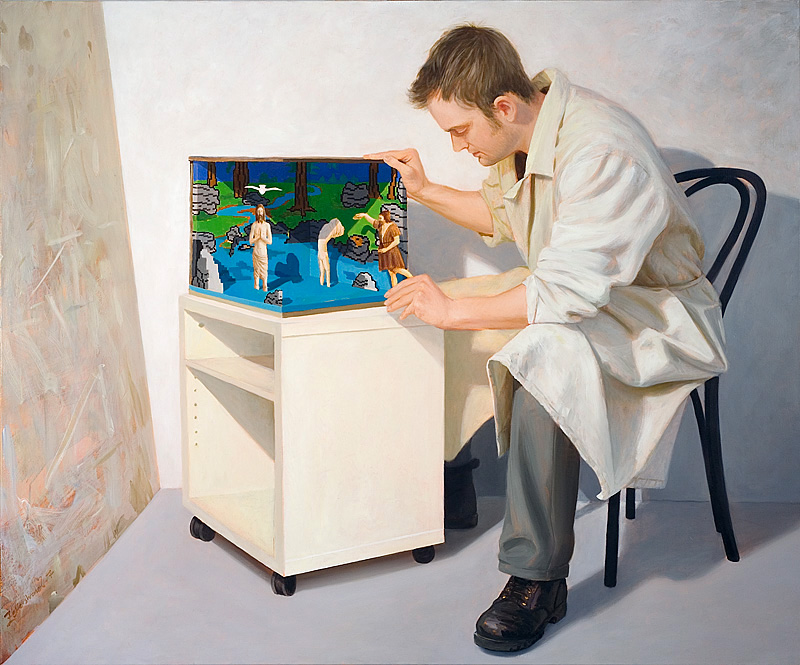
GameScenes: Many of your paintings could be described as “meta-art”. Consider, for instance, the impressive diorama titled “The Game”. Can you tell me something about the process of creating a game-based painting or a diorama?
Kristoffer Zetterstrand: I am interested in how structures mix and create new forms and meanings, and a painting in itself is just that, a combination of layers and textures that form a new whole. Also, since I trained in a classical painting tradition from the start, I have some experience in the technical aspects of ‘building’ a painting by using underpaintings, transparent paint layers and such. I try to use these techniques and sometimes to exaggerate them so that the makeup of the the painting become very visible in the finished result. In a way, I also work much like a game designer in the construction of the scenes. For some years, my process consists in sculpting all my scenes in 3D in the computer before I paint them, creating a kind of “virtual still lifes”. This means that during the whole process of sketching, given the methods of sculpting in 3D, I am very aware of the logical construction and “physicality” of the whole scene, from the inside and out. I can rotate the scene, and move my “actors” around and rearrange the lighting. The virtual camera used to render the final scene can also be moved and changed throughout the process, enabling me to try out an indefinite number of points of view. I often have rendered hundreds of candidate images for the scene before choosing the right one. It takes a lot of time. For example, the painting you mentioned, “The game”, took me three months to virtually sculpt using Maya before I decided I had a motif to use for painting.
GameScenes: How do you see the relationship between the artist and the game designer, the canvas and the screen?
Kristoffer Zetterstrand: In order not to break the ilusion in a game, the game designer needs to stay out of the picture, but I sometimes find the traces of the creation of the game to be an interesting addition to the experience, like in a Brechtian Verfremdung effect. Encountering bugs in a game is an example of such a moment, when your immersion in the game is shattered, and instead of being scared of the monster, you laugh at it being stuck halfway through the ceiling. The imperfections remind us of the creator, the artist or the game designer, and sometimes brings us closer to the intentions of the artwork. The hand in “Pointer” was meant as a hand belonging to another realm of realism than that of the karate fighter, and the background (from Caspar David Friedrich) yet another. But I never thought of Michelangelo’s painting as I did the picture, believe it or not. It was afterwards, when someone pointed it out, that I saw the obvious connection. So in a way, I had a bug in my painting.
GameScenes: In Sweden you are a successful artist. Do you think you would have the same success if you only worked with digital media, making for example artistic videogames, and not figurative paintings?Kristoffer Zetterstrand: I have no idea. I actually worked a little with computer game graphics in the early 90’s, And I made a map for Counter-Strike (called de_priory) a couple of years ago as a way to teach myself the tools to make 3D worlds. I downloaded the free apps used to make Counter-Strike, like Worldcraft and Terragen, and also ended up creating over 200 custom textures for the game. In the end, by learning these tools I found a new way of sketching scenes to use in my paintings. I have now gone over to Maya as my 3D sketching tool, but the idea is still the same. I am still fascinated by the techniques of game creation, and I believe that I could have worked in the game design business, had I not found myself all too captured by painting.
GameScenes: How would you describe the attitude to Game Art in Sweden today?
Kristoffer Zetterstrand: I have actually never considered myself to be making “Game Art”, but I guess my influences from games, as well as the tools I’m using could sometimes include my work in that category. I think that the last few years have seen an increased media interest in gaming in general, with game reviews in major newspapers and e-sport on television. In 2002 there were very little talk of Game Art, and of course it has gotten more respect since then, but it is still in its infancy.
GameScenes: What’s your personal relationship to computer games? Do you have time to play these days?
Kristoffer Zetterstrand: Actually, the last year I have played quite little because of too much work. But recently after my last solo show, I have found some time to play a few games that I never got to finish earlier. So I just played through Fallout 3, and I’m going to finish Bioshock now. I am looking forward to the next episode of Half-Life 2.
Text by Mathias Jansson.
Commission: Vallentuna Kulturhus
Mounted stained glass and printed glass panes. Proposed work for Vallentuna Culture house / Library. Commissioned by The National Public Art Council / Statens Konstråd. Scheduled to be finished in 2012. HQ animation here
Artist talk, SAK, Liljevalchs konsthall
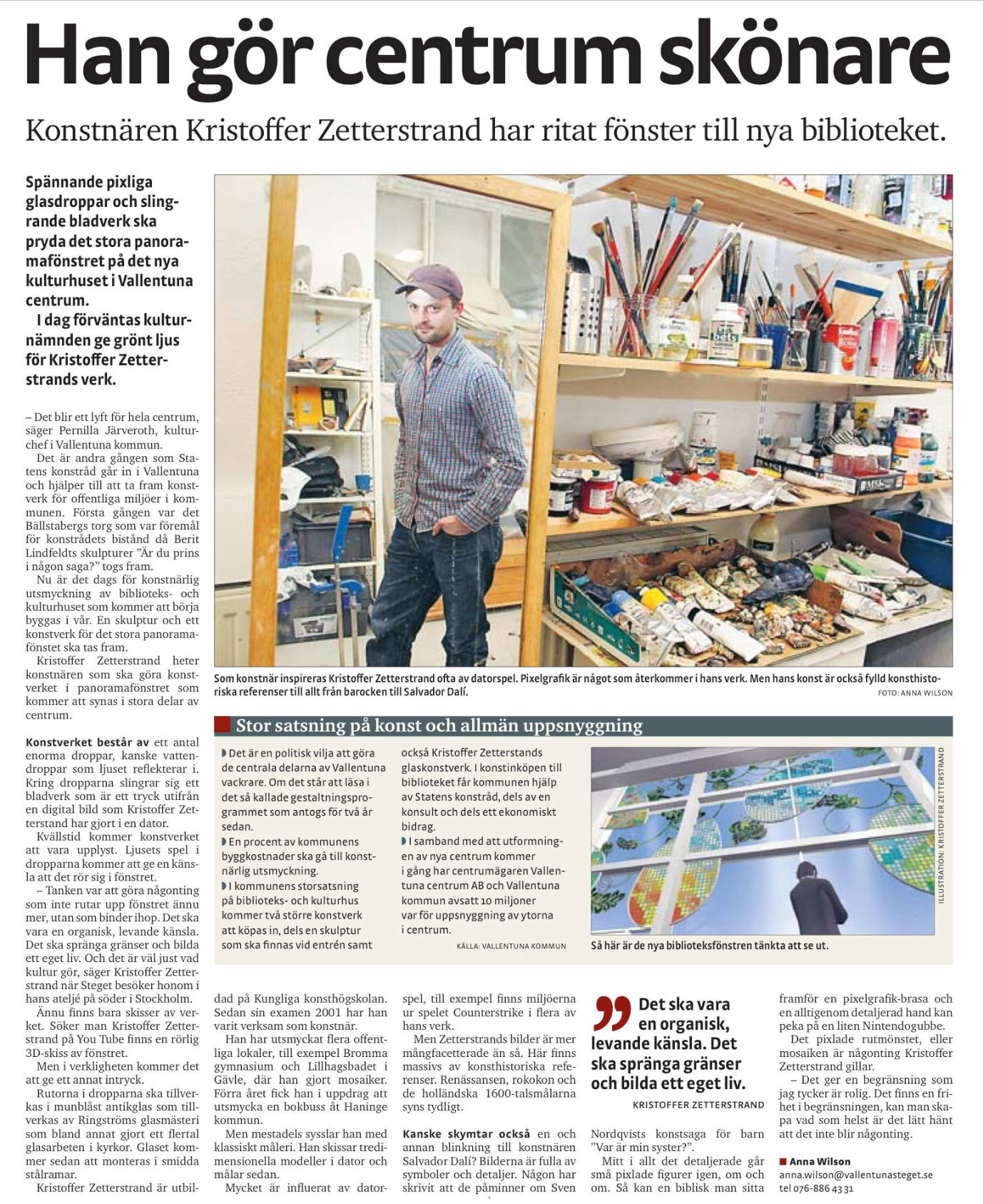
Interview, Dagens Nyheter
Intervju – Veckans spelare
Surfaces
Kristoffer Zetterstrand. Solo show. March 13 – 28
Galleri PS, Kaponjärgatan 4, Gothenburg
Opening Saturday March 13, 12.00-16.00. facebook event
Minecraft art
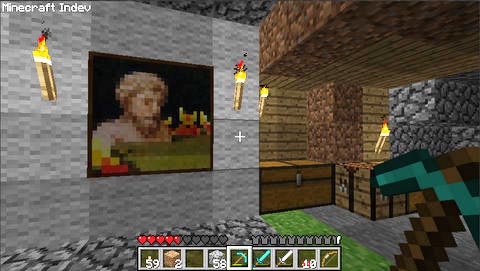
19 paintings re-crafted and made for the excellent game Minecraft by Notch.
Make them in the game from wood and wool.
Available in the latest update of the game.
Market 2010

Participating at Market 2010 with ALP / Peter Bergman
February 19-24
Exhibition website
The Royal Swedish Academy of Fine Arts (Konstakademien)
Fredsgatan 12
Stockholm