Första konsten på NKS invigd

 – Ett toppmodernt universitetssjukhus måste självklart också ha konst och gestaltning av högsta klass. Konsten i och runt Nya Karolinska Solna bidrar till att markera byggnadens och verksamhetens stora betydelse i den växande storstaden. Jag är stolt över att inviga den första konstnärliga gestaltningen i Sveriges största offentliga konstsatsning, säger produktions- och kulturlandstingsrådet Anna Starbrink (FP).
Kakelmosaiken ”Ager Medicinae” eller ”det medicinska landskapet” skildrar i en ungefärlig tidsaxel den medicinska utvecklingen med referenser till medicin, sjukvård och filosofi.
– Ett toppmodernt universitetssjukhus måste självklart också ha konst och gestaltning av högsta klass. Konsten i och runt Nya Karolinska Solna bidrar till att markera byggnadens och verksamhetens stora betydelse i den växande storstaden. Jag är stolt över att inviga den första konstnärliga gestaltningen i Sveriges största offentliga konstsatsning, säger produktions- och kulturlandstingsrådet Anna Starbrink (FP).
Kakelmosaiken ”Ager Medicinae” eller ”det medicinska landskapet” skildrar i en ungefärlig tidsaxel den medicinska utvecklingen med referenser till medicin, sjukvård och filosofi.
 – Det är inte meningen att mosaiken ska vara en rebus, men det finns små halvt gömda inslag som en återkommande betraktare kan upptäcka efter hand, berättar konstnären Kristoffer Zetterstrand.
Mosaiken är konstruerad som lågupplöst pixelgrafik, vilket konstnären tidigare arbetat med. Längst till höger i den medicinska tidslinjen finns en halvt dold QR-kod i mönstret, som kan läsas om man står framför mosaiken med en streckkodsläsare (en mobilapp). QR-koden länkar vidare till en webbsida där konstverket förklaras vidare i en interaktiv form.
– Det är inte meningen att mosaiken ska vara en rebus, men det finns små halvt gömda inslag som en återkommande betraktare kan upptäcka efter hand, berättar konstnären Kristoffer Zetterstrand.
Mosaiken är konstruerad som lågupplöst pixelgrafik, vilket konstnären tidigare arbetat med. Längst till höger i den medicinska tidslinjen finns en halvt dold QR-kod i mönstret, som kan läsas om man står framför mosaiken med en streckkodsläsare (en mobilapp). QR-koden länkar vidare till en webbsida där konstverket förklaras vidare i en interaktiv form.
 Stockholms läns landsting har av tradition lagt stor vikt vid satsning på konstnärlig utsmyckning i sjukhusmiljöer vilket enligt forskning bidrar till hälsa och tillfrisknande. Konsten på Nya Karolinska Solna ska skapa en visuellt attraktiv miljö som förhöjer byggnadernas inre och yttre, dagtid såväl som kvällstid. Det leder till att personalen får en bättre arbetsmiljö och framför allt att patienterna får en bättre upplevelse av sin sjukhusvistelse.
Läs mer om konsten på NKS
Foto: Holger Staffansson och Lina Ivarsson, Skanska
Stockholms läns landsting har av tradition lagt stor vikt vid satsning på konstnärlig utsmyckning i sjukhusmiljöer vilket enligt forskning bidrar till hälsa och tillfrisknande. Konsten på Nya Karolinska Solna ska skapa en visuellt attraktiv miljö som förhöjer byggnadernas inre och yttre, dagtid såväl som kvällstid. Det leder till att personalen får en bättre arbetsmiljö och framför allt att patienterna får en bättre upplevelse av sin sjukhusvistelse.
Läs mer om konsten på NKS
Foto: Holger Staffansson och Lina Ivarsson, Skanska
Karolinska smyckas med konst för 118 miljoner kronor
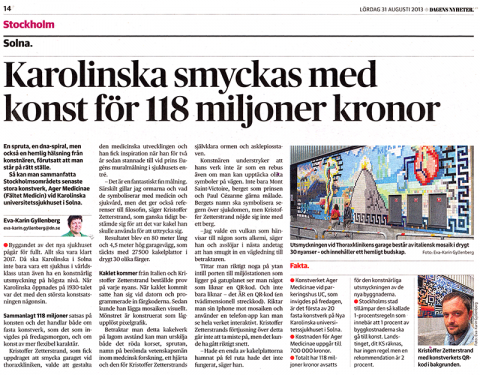
Dagens Nyheter 130831 (PDF)
En spruta, en dna-spiral, men också en hemlig hälsning från konstnären, förutsatt att man står på rätt ställe. Så kan man sammanfatta stockholmsområdets senaste stora konstverk, Ager Medicinae (Fältet Medicin) vid Karolinska universitetssjukhuset i Solna.
Byggandet av det nya sjukhuset pågår för fullt. Allt ska vara klart 2017. Då ska Karolinska i Solna inte bara vara ett sjukhus i världsklass utan även ha en konstnärlig utsmyckning på högsta nivå. När Karolinska öppnades på 1930-talet var det med den största konstsatsningen någonsin. Sammanlagt 118 miljoner satsas på konsten och det handlar både om fasta konstverk, som det som invigdes på fredagsmorgon, och om konst av mer flexibel karaktär.
Kristoffer Zetterstrand, som fick uppdraget att smycka garaget vid thoraxkliniken, valde att gestalta den medicinska utvecklingen och han fick inspiration när han för två år sedan stannade till vid prins Eugens muralmålning i sjukhusets entre. -Det är en fantastiskt fin målning. Särskilt gillar jag ormarna och vad de symboliserar med medicin och sjukvård, men det ger också referenser till filosofin, säger Kristoffer Zetterstrand, som ganska tidigt bestämde sig för att det var kakel han skulle använda för att uttrycka sig. Resultatet blev en 80 meter lång och 4,5 meter hög garagevägg, som täckts med 27 500 kakelplattor och drygt 30 olika färger. Kaklet kommer från Italien och Kristoffer Zetterstrand beställde prov på varje nyans. När kaklet kommit satte han sig vid datorn och programmerade in fårgkoderna. sedan kunde han lägga mosaiken visuellt. Mönstret är konstruerat som lågupplöst pixelgrafik. Betraktar man detta kakelverk på lagom avstånd kan man urskilja både det röda korset, sprutan, namn på berömda vetenskapsmän inom medcinsk forskning, ett hjärta och den för Kristoffer Zetterstrand självklara ormen och asklepiosstaven. Konstnären understryker att hans verk inte är som en rebus även om man kan upptäcka olika symboler på vägen. Inte bara Mont Saint-Victoire, berget som prinsen och Paul Cezanne gärna målade. Bergets namn ska symbolisera segern över sjukdomen, men Kristoffer Zetterstrand nöjde sig inte med ett berg. -Jag valde en vulkan som hänvisar till någon sorts alkemi, säger han och avslöjar i nästa andetag att han smugit in en vägledning till betraktaren.
Tittar man riktigt noga på ytan intill porten till miljöstationen som ligger på gatuplanet ser man något som liknar en QR-kod. Och inte bara liknar- det ÄR en Q R-kod (en tvådimensionell streckkod). Riktar man sin Iphone mot mosaiken och använder en telefon-app kan man se hela verket interaktivt. Kristoffer Zetterstrands förtjusning över detta går inte att ta miste på, men det kunde ha gått riktigt snett. -Hade en enda av kakelplattorna hamnat på fel ruta hade det inte fungerat, säger han.
Fakta.
-
Konstverket Ager Medicinae vid parkeringshus U2, som invigdes på fredagen, är det första av 20 fasta konstverk på Nya Karolinska universitetssjukhuset i Solna.
-
Kostnaden för Ager Medicinae uppgår till 700 000 kronor.
-
Totalt har 118 miljoner kronor avsatts för den konstnärliga utsmyckningen av de nya byggnaderna.
-
Stockholms stad tillämpar den så kallade 1-procentsregeln som innebär att l procent av byggkostnaderna ska gå till konst. Landstinget, dit KS räknas, har ingen regel men en rekommendation är 2 procent.
Eva-Karin Gyllenberg
Dagens Nyheter, 2013-08-31
Det första och största konstverket
Clip from:
ABC-nytt, 2013-03-30
Sveriges största offentliga konstsatsing
Nyheterna, TV4, 2013-08-30
Ager Medicinae tile mosaic opening
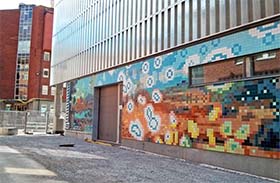
27500 tiles, 81 x 4,2 meters. Welcome to the public opening
When: fr, 30 aug, 11:00 – 13:00
Where: Parking house outside Thorax, Karolinska universitetssjukhuset. Map here
Google+ event here
At the heart of care
He is bigger than Picasso and Dali – at least in terms of square meters. Kristoffer Zetterstrand has created a 300-square-meter work that covers two walls at NKS. Zetterstand is the first of a number of artists that will lend culture and beauty to the new university hospital.
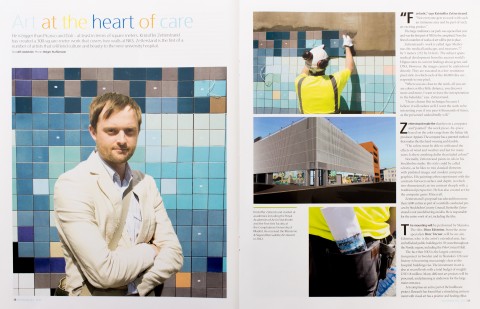
Skanska Worldwide PDF
“Fantastic,” says Kristoffer Zetterstrand. “Not everyone gets to work with such an immense area and be part of such an exciting project.”
The large multistory car park was opened last year and was the first part of NKS to be completed. Now, the first of a number of works of art will be put in place. Zetterstrand’s work is called Ager Medicinae, the medical landscape, and measures 77 by 5 meters (252 by 16 feet). The subject spans medical development from the ancient world’s Hippocrates to current findings about genes and DNA. However, the images cannot be understood
directly. They are executed in a low-resolution pixel style in which each of the 40,000 tiles corresponds to one pixel. “When you are close to the work, all you see are colors; with a little distance, you discover more and more. I want to leave the interpretation to the beholder,” says Zetterstrand.
“I have chosen this technique because I believe it will endure well. I want the work to be interesting even if you pass it thousands of times, as the personnel undoubtedly will.”
Zetterstrand made the sketches on a computer and “painted” the work piece–by–piece based on the color range from the Italian tile producer Appiani. The company has a patented method that makes the tiles hard-wearing and durable. “The colors must be able to withstand the effects of wind and weather and last for many years. Is there anything duller than faded colors?” Normally, Zetterstrand paints in oils in his Stockholm studio. His style could be called eclectic, as he likes to mix classical elements with pixilated images and modern computer graphics. His paintings often experiment with the contrasts between surface and depth, in which two-dimensional cut-ins contrast sharply with a traditional perspective. He has also created art for the computer game Minecraft.
Zetterstrand’s proposal was selected from more than 1,000 entries as part of a carefully conducted process by Stockholm County Council. Kristoffer Zetterstrand is not just delivering an idea. He is responsible for the entire work of art, including the tiles. The mounting will be performed by Skanska. The tiler, Dino Edström, from the stone specialists Bror Törner, will be on-site. Edström, who is the artist’s extended arm, has embellished public buildings or 38 years throughout the Nordic region, including the Oslo Concert Hall. The fact that NKS is the largest construction project in Sweden and in Skanska’s 126 year history is becoming increasingly clear as the hospital buildings rise. The investment in art is also at record levels with a total budget of roughly USD 18 million. Many different art projects will be procured, and planning is underway for the large main entrance. Art comprises an active part of the healthcare project. Research has found that a stimulating environment with visual art has a positive and healing effect.
Prosthetic Knowledge Picks: The Gaming Canvas
Article Here:
http://rhizome.org/editorial/2013/may/1/prosthetic-knowledge-picks-gaming-canvas/
Kristoffer Zetterstrand
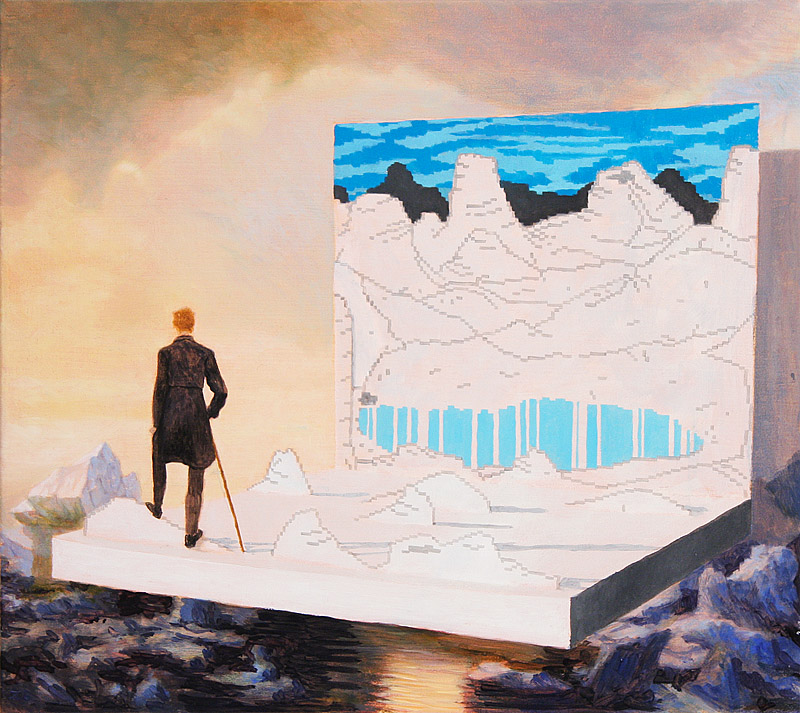
Kristoffer Zetterstrand, Wanderer (2008). 33×37 cm oil on canvas.
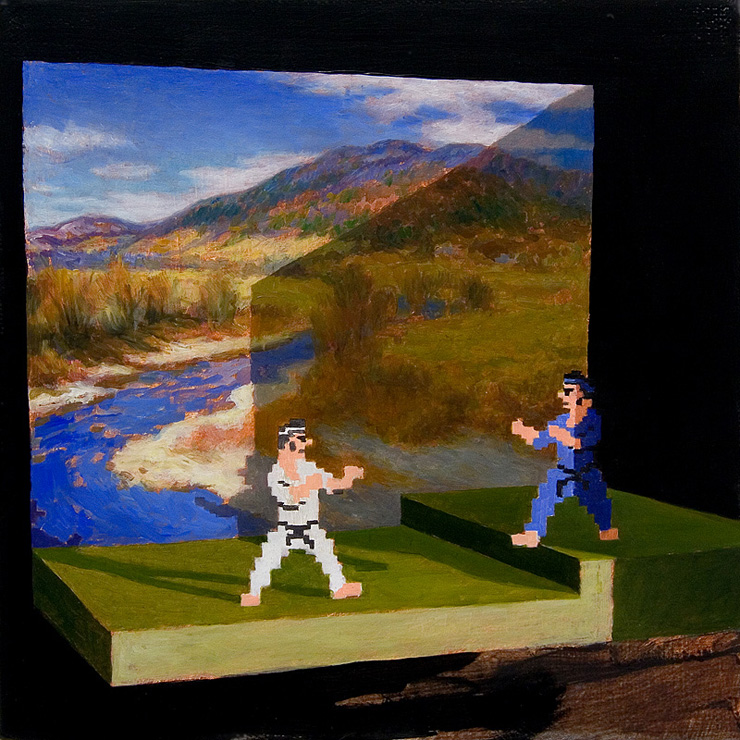
Kristoffer Zetterstrand, Fighters (2007). 20x20cm oil on canvas.
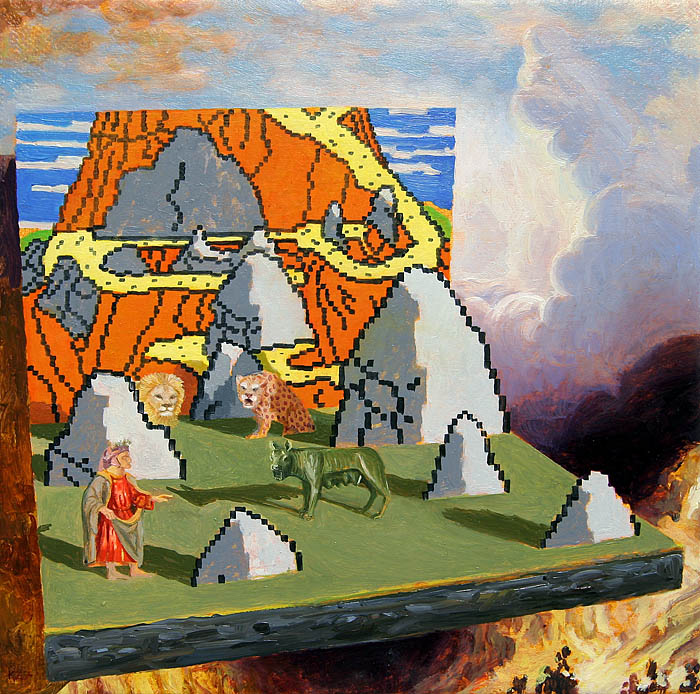
Kristoffer Zetterstrand, Dante and the Three Beasts (2007). 20x20cm. Oil on canvas.
Zetterstrand’s work (since 2002) has combined space, perspective, historical fine art and the presentation of video games. As the artist explains,
I work with painting. For some years I have experimented with virtual still lifes, often in the form of stage design in which I explore how two-dimensionality (and painting) relates to computer-generated 3D worlds. I am interested in visual spaces created online, in computer games and 3D programmes, and especially in what happens when the illusion is shattered and the underlying construction emerges -like when there is a bug in a computer game. I am interested in visual failures, which I try to use in my painting. Among other things, I have produced paintings based on the landscapes that you can see only if you are “dead” in the online game Counter-Strike, and paintings with motifs created by crashed landscape generators used in film and computer game production. Presently my work process is like this: I start by sketching the motif in 3D on the computer, where I can move the scene about, rearrange pictorial elements, redirect the light, reposition the camera, and so on. I sculpt the architecture and the various parts of the environment and dress the parts in different textures, which I often sample from images of my own earlier paintings, from pictures I have found on the net and screen dumps from computer games. I also use a lot of material from my art archives, which comprises some sixty-thousand paintings. While working with a sketch on the computer, the simpleness of the tools means that I can follow my impulses and try out new angles, change backdrops and pictorial elements, redirect the light, rearrange the shadows, etc. For me, the 3D programme is a tool that I use intuitively when I construct my motifs. The scenes are often influenced by the dramatic composition of computer games, where familiarity with some kind of mythology is essential in order to play the game, in a similar way as an artist relates to art history. That the end result is painting is a prerequisite of my work. The physical aspect of painting and the space it allows for improvisation and painterly reformulations of the motifs are the most important parts of the process. You could say that when it comes to the painterly part of my work process, I improvise on a theme that I have determined on the computer.
Reportage, SVT Sverige
SVT Sverige!
Avsnitt 4, 2012
Sändes 9/2 19:00
Reportage, ABC
ABC-Nytt
Super-Mario i Konsthallen
Sändes 2013-01-30, 17:35
Work grant

Receives a two year work grant from the Swedish Arts Grants Committee.