Retro video games
 Opening 14th April, 19.30 – 21.30
Lilla galleriet, Urban outfitters. Biblioteksgatan 4
Johan Thurfjell, Cory Archangel, Andreas Ribbung, Arne Kjell Vikhagen, Kristoffer Zetterstrand
Opening 14th April, 19.30 – 21.30
Lilla galleriet, Urban outfitters. Biblioteksgatan 4
Johan Thurfjell, Cory Archangel, Andreas Ribbung, Arne Kjell Vikhagen, Kristoffer ZetterstrandIn beta perpetua
Minecraft review by Matteo Bittanti
Rolling Stone, February 2011, page 138
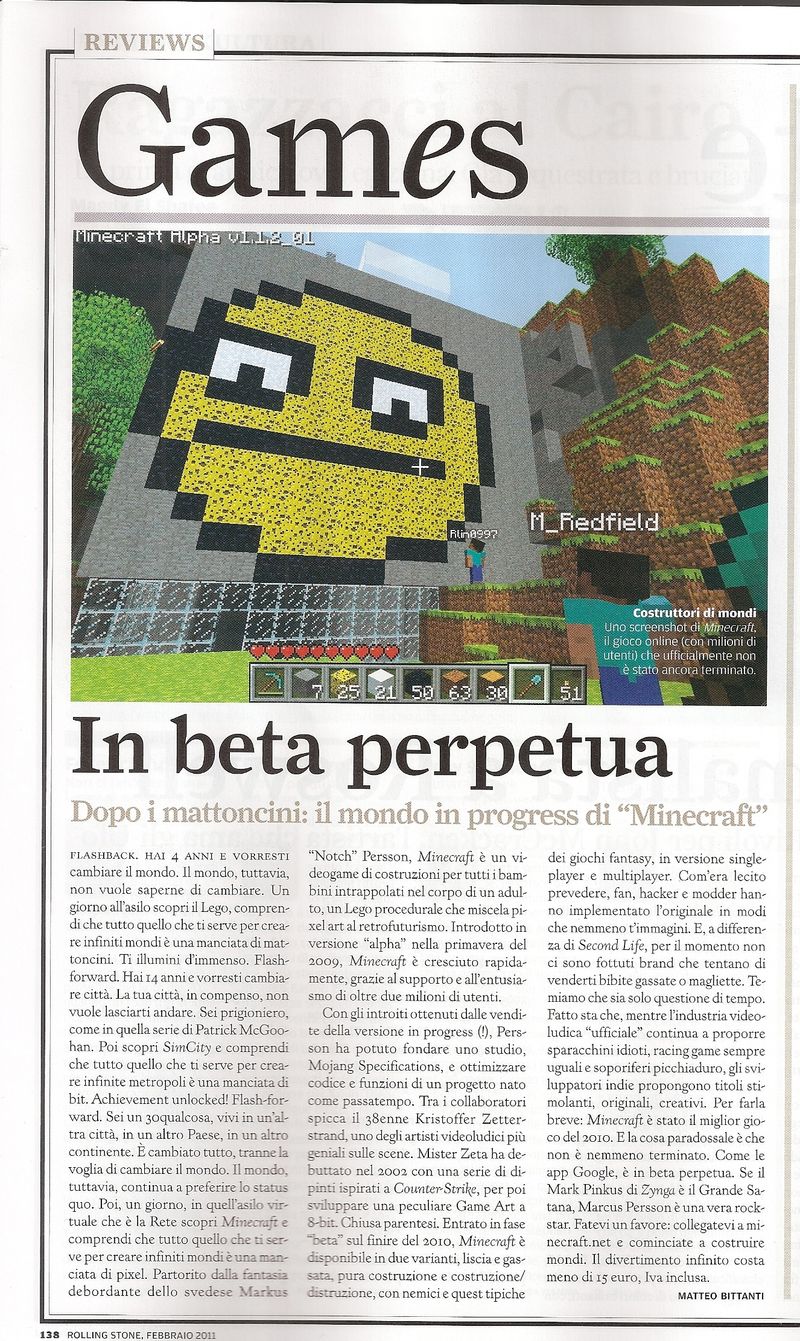
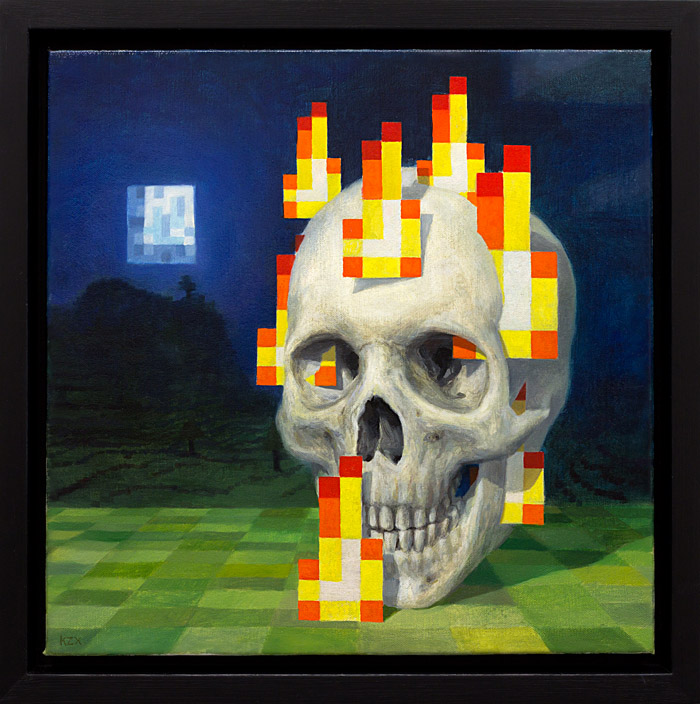
 Among the outstanding contributors is the 38 year-old Kristoffer Zetterstrand, one of the most brilliant videogame artists on the scene. Mr Z made his debut in 2002 with a series of paintings inspired by Counter-Strike, and later developed a unique type of 8-bit Game Art
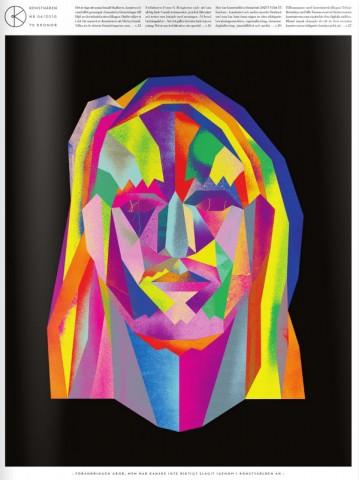
Konsthistoria för dataspelsgenerationen
Read the full article here: [swe] http://www.magasinett.net/start/doc.php?did=555
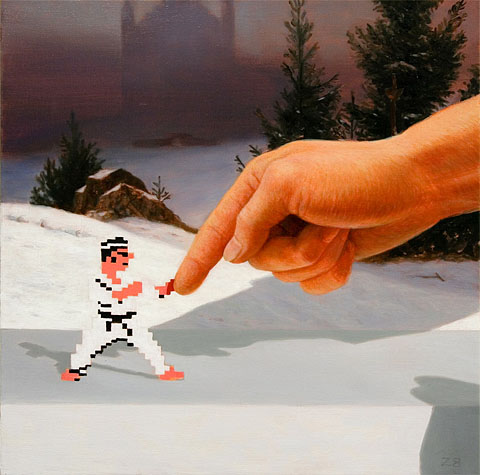
Det religiösa motivet kan vi även hitta i den svenska konstnären Kristoffer Zetterstrands målning ”Pointer” från 2008. Vi ser på bilden hur en stor hand kommer in från höger och pekar på en liten Kung Fu karaktär i mitten av målningen. En ganska kantig grafisk karaktär som verkar vara hämtad från ett dataspel från 80-talet. Zetterstrand har själv sagt att inte tänkte på Michelangelos berömda takmålning i Sixtinska kapellet när han skapade verket, den del av kapellets tak som visar hur Gud sträcker fram sitt finger och skapar Adam. En detalj som har parafraserats och parodierats på många olika sätt under historiens gång. Jag tänkte i alla fall på den parallellen, och jag tror även att många andra ser den likheten. Det finns även en parallell i målningen på ett högre plan. Gud skapade människan enligt Bibeln, men människan försökte sedan skapade egna avbilder, dels i konsten, men också genom virtuella karaktärer i t ex dataspel. I ”Pointer” kan vi spåra en sekularisering och popularisering av det kända motiv från kristendomens bildvärld. Vi säger inte längre att det är Gud som skapat människan och världen, utan istället är det vi själva som har förmågan att skapa virtuella karaktärer och världar. I dataspelen kan vi låstas att vi själva är gudar och bestämma vad som ska hända med våra karaktärer och världen de lever i.
Boxworld
Interview made for GEE Magazine
By Christian Neeb
Original interview in german here
I also studied for a while in Madrid, and I spent my days almost equally divided between drawing at the Prado Museum, and playing Half-Life Deathmatch at an Internet cafe.
Maybe you could tell me something about your background? When did you start painting and why did you decide, that perspective should be an elemental part of your work?
I started painting seriously when I attended my first art school at eighteen. I didn’t have any other plan to begin with, except learning as much as possible – and I was very focused on the technique in the beginning. I began studying picture composition a lot, and I was fascinated by the work of the Italian renaissance, especially Piero Della Francesca. The invention of linear perspective during the renaissance transformed the imagery of the western world, and we are now so used to it that we take it for granted. Our 3D software for example relies on it. Since I am interested in how human imagination creates worlds, I guess that is part of the answer. However, I never decided that the issue of perspective would form part of my work, but since it always has intrigued me, I keep coming back to it. It’s the same with the Pythagorean ideas on mathematics, the harmony of numbers and the Fibonacci series. I have to test it out. For example, the painting series called “Levels” (2006) – which depicts “Graham” from “King’s quest” walking through different scenarios, each canvas being a level in his adventure – were all composed extremely methodically upon the Golden ratio.
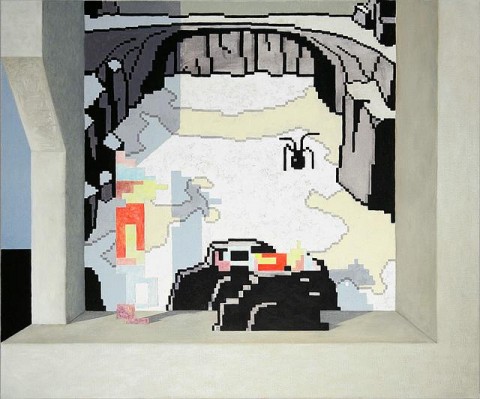
In your paintings classic pieces of art like Caspar David Friedrichs “Der Wanderer über dem Nebelmeer” merge with imagery from retro-games like the Sierra Adventures. What is your intention by doing this?
The blending of different imagery comes partly from my wish to give the various pictorial elements equal importance, to maintain a level playing field in my scenes.
For example, I’d like to give a 8-bit flower the same respect as a cut-out from a 15th century oilpainting by Bellini. I also treat them in the same way by keeping the sampled imagery projected on flat surfaces, even though they inhabit three-dimensional space.
By contrasting the flatness of cut-out images with the shadows that they cast from the virtual lighting, their flatness is exaggerated at the same time as the 3D-space is rendered more illusory. By also contrasting pixelated elements from old games with more naturalistic parts, such as the one you mention from Friedrich, a new story can be told in which I don’t need to adhere to the conventions of a specific “reality level”. The resulting image has its own reality, its own rules. I’d like to think of it in a way as a stage play at the theater that can immerse the audience, even though the set design is obviously constructed out of painted cheap wooden planks.
In your mix between pixel and paint, the human being, the artist becomes a part of the artwork, while still being an outsider, an observer. What is your relationship to your paintings?
Being the artist, I’m both the creator and the spectator in relation to the painting. In some of my pictures, I have included a figure that interacts with or contemplates the scene, and who could be interpreted as the creator of it, but perhaps also as someone merely exposed to it. By also treating this figure as a textured flat plane, the border between the figure and the rest of the scene gets blurred, and the creator, if he/she is to be seen as such, gets incorporated into the world he/she created. I like that idea.
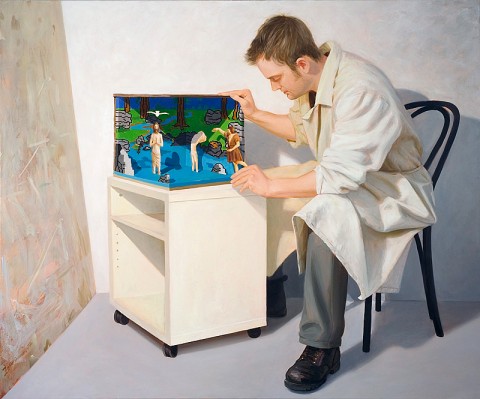
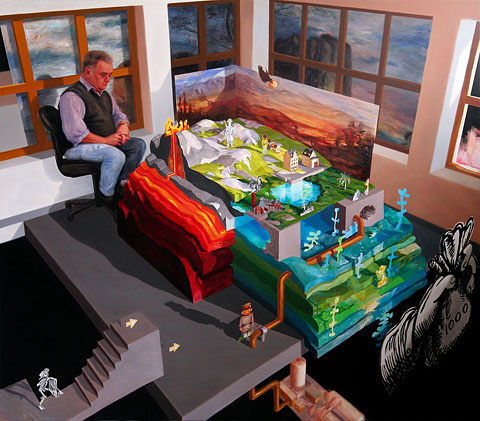
In your selfportrait, that we printed in our magazine, one can see yourself being part of your own work, the picture of yourself touching the diorama you created. Would you think of this picture rather as a symbolic one, or does it represent a real desire, maybe to touch a virtual world with your bare hands?
It has to do with the different levels of realism i mentioned earlier, and also in that specific painting, it tells a story about the relation between an artist and his motif.
The painting is called “Artist and Still Life”, and in it, I have dressed up as an “artist”, complete with a white painter’s coat. (Which I do not use IRL) The still life in the picture represents a world that may be imaginary in the mind of the artist in the image, but he is at the same time playing with it in the same pictorial space that he himself exists in. I would say that it does represent a real desire, as you say, but in a way that desire is partly fulfilled in this case, because when I painted that picture I did touch a virtual world with my bare hands – the painting itself.
Have you ever thought about creating a game and implementing acrylic or oil elements in the graphics of the game? If so which genre would you choose? What would fit your creative style most gameplay-wise?
I have made some stuff for fun where I have implemented painting elements into game worlds, for example when I put Piero Della Francesca’s frescos into a Counter-Strike map I made (de_priory). I started making a map for Counter-Strike just to learn the tools, so that I could use them later to construct 3D worlds of my own, but I couldn’t resist making my own textures too, some of them based on my paintings. Also, pixel-versions of many of my paintings can be found in the game Minecraft. That’s extra fun, because many of those paintings have old school pixel graphics in them, and here they are, back inside a game again – transferred from pixels to paint and to pixels again, and you can make them in the game from wool and wood. If I were to put “painted objects” in a future game, I would perhaps consider making an adventure style game, like “Grim Fandango”. That would be great.
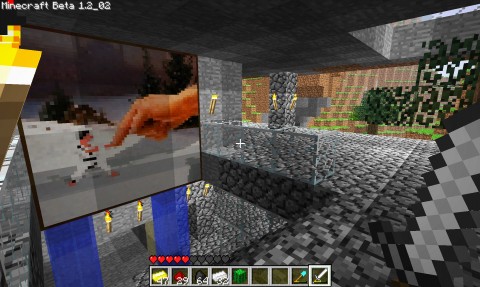
pixel-painting in Minecraft
——————————————————————————————–
By Christian Neeb
Schachtelwelten
——————————————————————————————–
Schachtelwelten
In der aktuellen Ausgabe von GEE stellen wir euch den schwedischen Künstler Kristoffer Zetterstrand vor, der aus klassischer Malerei, Retrografik und 3D-Perspektiven großartige Kunst-Remixe erstellt. Im Interview gibt er einen Einblick in seine Arbeit, Inspirationsquellen und seine Liebe zu Videospielen.
Wie kam es zu deiner Entscheidung, Malerei und Videospiel-Ästhetik zu vereinen?
Ich bin in Stockholm aufgewachsen, aber einige Jahre lang ist meine Familie quer über den Kontinent gereist. Ich habe eine Weile in Dänemark gelebt. Und in Frankreich, hauptsächlich in Paris. Ich war zwölf Jahre, als ich nach Paris kam. Die Stadt hat mich stark beeinflusst. Ich hatte schon immer gemalt und gezeichnet, aber dort nahm alles an Fahrt auf. Die Museen übten eine starke Anziehungskraft aus. Ich saß einfach dort und malte. Als Teenager begann ich auch, die frühen PC-Spiele wie „Wasteland“ und „King’s Quest“ zu spielen. Später erstellte ich sogar Pixel-Art für einen Spielentwickler, aber als ich mein Studium an einer Kunsthochschule begann, konzentrierte ich mich zunächst wieder auf die Malerei. Gegen Ende meiner Studienzeit in Madrid floß beides ineinander. Meine Tage bestanden zu gleichen Teilen aus Malerei im Prado Museum und „Half-Life“-Deathmatch-Partien im Internetcafé, und ich begann, mit Computer-Bildern in meinen Gemälden zu experimentieren.
Wieso ist Perspektive ein elementarer Bestandteil deiner Arbeit?
Ich war schon früh fasziniert von den Werken der italienischen Renaissance, besonders von Piero Della Francesca. Die Erfindung der linearen Perspektive während der Renaissance änderte die Bildwelt der westlichen Hemisphäre. Heute sind wir so an sie gewöhnt, dass wir sie als selbstverständlich erachten und beispielsweise unsere 3D-Software auf sie angewiesen ist. Ich interessiere mich außerdem dafür, wie die menschliche Vorstellungskraft Welten erschafft. Trotzdem habe ich nie explizit entschieden, dass die Frage nach Perspektive ein Teil meiner Arbeit sein soll. Da sie mich aber so fasziniert, komme ich immer wieder auf sie zurück. Mit dem pythargoräischen Verständnis von Mathematik, der Harmonie der Zahlen und den Fibonacci-Serien ist es ähnlich. Die Serie von Gemälden namens „Levels“ (2006) beispielsweise, in der Graham aus „King’s Quest“ dargestellt wird, wie er durch verschiedene Szenarien wandelt, jede Leinwand ein Level aus seinem Abenteuer, habe ich extrem methodisch mit dem Goldenen Schnitt komponiert.
In deinen Gemälden vermengen sich klassische Werke mit Bildkompositionen aus Retro-Spielen. Was ist der Grund für diesen Ansatz?
Der Mix entsteht aus dem Wunsch, verschiedenen bildlichen Elementen die gleiche Bedeutung zu verleihen und dabei ein Stück spielerische Freiheit in meinen Szenen zu erhalten. Ich mag es, einer 8-Bit-Blume den selben Respekt entgegen zu bringen wie einem Ausschnitt aus einem Ölgemälde von Bellini aus dem 15. Jahrhundert. Ich behandele sie in der gleichen Weise, indem ich die Bildelemente auf flache Oberflächen projiziere, obwohl sie einen dreidimensionalen Raum einnehmen. Indem ich die Flächigkeit von ausgelösten Bildelementen mit ihren Schatten im virtuellen Licht kontrastiere, wird ihre Flächigkeit vollkommen überspitzt. Zugleich erhält dabei aber auch der dreidimensionale Raum etwas unwirkliches.
Indem ich pixelige Elemente aus alten Spielen mit naturalistischen Kunstwerken kontrastiere, zum Beispiel Caspar David Friedrichs „Der Wanderer über dem Nebelmeer“ , kann ich eine neue Geschichte erzählen, in der ich mich nicht an die Konventionen einer bestimmten Realität halten muss. Das Resultat ist ein Bild, das seine eigene Realität hat, seine eigenen Regeln. Ich vergleiche das gerne mit einem Theaterstück, welches das Publikum in seinen Bann zieht. Und das obwohl man klar sehen kann, dass das Bühnenbild aus angemalten, billigen Holzlatten besteht.
In deiner Mischung aus Farbe und Pixeln wird der Künstler zum Teil des Kunstwerks und bleibt trotzdem Außenseiter und Beobachter. Was für ein Verhältnis hast du zu deinen Bildern?
Als Künstler übernehme ich bei meinen Gemälden sowohl die Rolle des Schöpfers als auch des Beobachters. In einigen von ihnen habe ich eine Figur integriert, die mit der Szenerie interagiert oder über sie sinniert, und die als ihr Schöpfer interpretiert werden könnte. Vielleicht ist sie ihr aber auch nur ausgeliefert. Da ich diese Figur ebenfalls als texturierte Fläche behandele verschwimmt die Grenze zwischen ihr und dem Rest der Szene. Ich mag den Gedanken, dass der Schöpfer, wenn man ihn so sehen will, in der Welt verankert ist, die er geschaffen hat.
In deinem Selbstporträt (siehe GEE 59), berührt dein Abbild ein Diorama, dass du geschaffen hast. Würdest du gerne Virtualität mit den Fingerspitzen berühren?
Das Gemälde heißt „Artist And Still Life“. In ihm habe ich mich selbst wie einen Künstler angezogen, komplett mit Kittel. Das mache ich im echten Leben nicht. Das Stilleben im Bild repräsentiert eine Welt, die vielleicht vollkommen im Geist des Künstlers besteht. Zugleich spielt er aber mit ihr im selben bildlichen Raum, in dem er selbst existiert. Ich würde sagen, dass es tatsächlich einen realen Wunsch repräsentiert. Auf eine Art habe ich mir diesen Wunsch aber schon erfüllt, denn als ich dieses Bild malte, habe ich diese virtuelle Welt mit meinen bloßen Händen berührt.
Wenn deine Bilder zum Spiel würden, welches Genre würde ihnen am besten zu Gesicht stehen?
Ich habe meine Gemälde bereits spielerisch verarbeitet. Beispielsweise in der „Counterstrike“-Map „(de_priory), in der ich mit Pierro Della Francescas Fresken gearbeitet habe. Ich wollte solche Maps eigentlich nur erstellen, um deren Werkzeuge zu erlernen und später eigene 3D-Welten zu erstellen. Aber ich konnte der Versuchung nicht widerstehen und musste einfach auch eigene Texturen in ihnen erstellen. Einige von ihnen basieren auf meinen Gemälden. Außerdem gibt es Pixel-Versionen einige meiner Gemälde in „Minecraft“. Das ist besonders witzig, denn viele meiner Bilder bestehen ja ohnehin zum Teil aus Old-School-Pixelgrafik. Jetzt sind sie wieder da, wo sie herkommen. Von Pixeln zum Gemälde zurück zu den Pixeln – und gemacht werden sie im Spiel aus Wolle und Holz. Wenn ich aber die Möglichkeit hätte tatsächlich gemalte Objekte in einem Spiel unterzubringen, wäre wahrscheinlich ein Adventure-Spiel meine erste Wahl. Wie „Grim Fandango“ – das wäre fantastisch.
Von Christian Neeb
Market 2011

Participating at Market 2011, Peter Bergman Gallery
February 18-20 @ The Royal Swedish Academy of Fine Arts (Konstakademien), Fredsgatan 12 Stockholm
Blickwechsel
Gee Magazine, März 2011

Hände, die Spielgrafik berühren, Gameplay, das in die Wirklichkeit ragt: Der Schwede Kristoffer Zetterstrand vereint in seinen Gemälden Naturalismus, Dioramen-Kunst und Pixelgrafik und erschafft Schachtelwelten, die die Grenze zwischen zweiter und dritter Dimension verwischen. Der Mensch ist dabei Aussenstehender und teil seiner Schöpfungen zugleich. Eine Galerie mit Bildern vor Kristoffer Zetterstrand gibt es unter www.geemag.de
Point of view
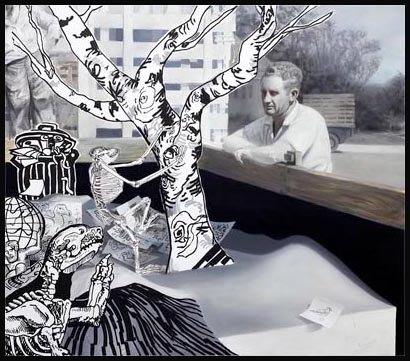
Kristoffer Zetterstrand. Solo show. Jan 29 – Mar 12
Kungsbacka Konsthall, Borgmästaregatan 6, Kungsbacka
Tekniken befriar konsten
Talk between Kristoffer Zetterstrand, Teresa Wennberg, Matti Kallioinen och Tove Kjellmark on art and technology
Read it online here [Swedish] (pages 32-37)
By Anders Rydell